Body Mapping in the Piano Studio


We would like to thank Kay S. Hooper for this insightful article about body mapping. To read the full article, click here.
On the count of three, point to the place where your upper arm meets your torso. One, two, three!

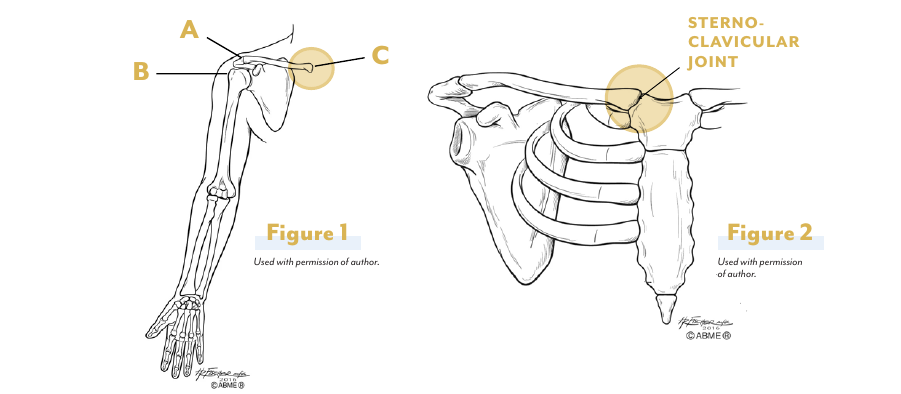
See Figure 1 below and find the place where you pointed. Most people point to the spot marked A, which they call the shoulder. If you did this, you are in good company.

However, this company is off the mark. The first joint of the arm is at C, the place where the collarbone (clavicle) meets the breastbone (sternum.) This joint is named the sterno-clavicular (S-C) joint because it is the meeting place of these bones. You can see this joint in Figure 2.

To find this joint, place the second finger of your right hand in the hollow at the top of the breastbone. Now move it toward the left in a slightly downward direction. You can feel a bone meeting the breastbone with a joint that may feel like a small crack. Keep your finger on this joint and move your left arm. What movement do you feel under your finger? Now freeze this joint and move your left arm. Does your arm move easily? Does it move at all?

If you’ve never had a Body Mapping experience before, you just had your first lesson. Body Mapping is the process of clarifying structures designed for movement.

If you encountered confusion about the first joint of the arm, the Body Mapping process of exploring joint movements and studying accurate images will help you correct this confusion.

When William Conable was teaching a class in Alexander Technique at The Ohio State University, he helped students find natural coordination through this hands-on process. Unfortunately, when they returned to practicing with their established patterns, they lost the ease of movement they had experienced during class, and he wondered why this was happening. Through keen observation and query, he discovered that they were moving according to misunderstandings about their structures. These misunderstandings are called “mismappings.” When these confusions were corrected, their movements improved.

We hope you enjoyed this excerpt from Kay S. Hooper’s article on body mapping. You can read the entire article by clicking here.

MORE ON BODY MAPPING

Not yet a subscriber? Join for only $7.99/mo or $36/yr.

The Body and the Beat: Developing Rhythm through Mindful Movement


We would like to thank Lesley McAllister for this insightful article on rhythm and movement. To read the full article, click here.

Movement, for children, is necessary for learning. Young bodies are fine-tuned sensory receptors collecting information, curious and eager to explore the world around them.1 The young child is in a period of sensitivity for gaining kinesthetic and sensory awareness, along with awareness of their own thoughts and emotions—which sometimes seem overwhelming. Learning through movement allows children to engage in joyful, intuitive experiences that lead to productive listening habits. This playful engagement keeps students attentive to their bodies while allowing abstract concepts like rhythmic notation to grow from natural experiences.

The joy of moving and responding to music is inborn, as seen in babies who dance by moving their bodies to music even before they can walk. There are strong two-way connections in the human brain between our auditory cortex and motor-control center.2 The rhythmic impulse is the driving force behind all music, and students who do not develop a strong sense of pulse early on in their musical studies may later lack melodic shaping, fluency, and momentum; in short, they will not sound musical.

Yet, for many teachers, the ways in which we work with rhythm are more mathematical than musical; students may learn to “count,” but not to truly feel the rhythmic drive in their bodies. The emphasis should not be just on rhythmic reading, but also on listening and responding to rhythmic patterns. While any musical concept can be experienced as whole-body movement, it is ideally suited for the internalization of pulse and the experience of contrasting tempi, meters, and rhythmic patterns.

The Benefits of Mindful Movement

When rhythmic practice is combined with slow, integrated movement, and particularly when used in correlation with the breath, the benefits are magnified. The positive impact of mindful movement on cognitive, physical, and emotional skills has been well-documented in research, with physical benefits including improved coordination, body awareness, and postural stability.

Mindful movement also boosts concentration and attention, increases memory, and improves the set of mental skills called “executive function skills,” which include the ability to plan, organize, and stay focused on tasks while resisting distractions. It enhances myelination between the two brain hemispheres, allowing for integrative processing across the whole brain, and relieves stress, resulting in better listening, comprehension, and retention of concepts.3

There are even musical benefits, too. Mindful movement increases auditory processing and responsiveness and assists with the development of the vestibular system or the inner ear, which is involved not just in balance and spatial orientation, but also in language processing and sound discrimination. With these benefits, mindful movement is particularly beneficial for children with special needs including those with ADHD, sensory processing disorder, anxiety, and autism.4

We hope you enjoyed this excerpt from Lesley McAllister’s article “The Body and the Beat: Developing Rhythm through Mindful Movement.” You can read the entire article by clicking here.

Notes

1 Carla Hannaford, Smart Moves: Why Learning is Not All in Your Head, 2nd ed. (Salt Lake City, UT: Great River Books, 2005), 92.

2 Adriana Barton, Wired for Music: A Search for Health and Joy through the Science of Sound (Berkeley, CA: Greystone Books, 2022), 36.

3 Lesley McAllister, Yoga in the Music Studio (New York: Oxford, 2020).

4 Lisa Flynn, Yoga for Children: 200+ Yoga Poses, Breathing Exercises, and Meditations for Healthier, Happier, More Resilient Children (Avon, MA: Adams Media, 2013), 56.

MORE ON HEALTHY MOVEMENT

Not yet a subscriber? Join for only $7.99/mo or $36/yr.

Do You Use Summer Lessons for Special Reading Activities?


We would like to thank Richard Chronister, Mary Ann Letti, and Berdine Ehrman for this insightful article on summer reading activities. To read the full article, click here.

Both writers for this issue’s Music Reading Department take the view that summer is special for piano students. A good case can be made for discontinuing the regular curriculum and making sure that summer study is something that makes the coming autumn a thing to look forward to rather than a thing to dread. 

I think that one of the most important aspects of this summer-difference is that the activities mentioned below are inherently reader builders. There is a vast difference between knowing how to read and being able to read fluently. Reading drills which ask students to name notes (saying or writing), to draw intervals, to spell chords, are drills on how to read; they are not drills in actual reading. The only thing that can truly be called a reading drill is reading a piece of music (notes, rhythm, dynamics) and even then, it is reading only if the piece is played in what could realistically be considered a tempo. Reading and playing slowly and carefully is for working out new repertoire; it contributes little to learning to be a fluent reader—unless the slow playing of a passage or piece is instantly followed by faster, in tempo, playing. 

Students must read some new music in tempo every week, every day of every week, if they are to become the fluent readers everyone of them is able to become. This, I think, is the most important aspect of the summer programs you will read about here. May I urge you to also include some of these ideas in your year through curriculum. Producing fluent readers remains our second priority, close behind our most important goal—fostering the joy of making music at the piano.

“Gimme a break”

By Mary Ann Lenti

Ah, summer vacation – the very sound of it conjures up images of hammocks, fishing poles, a sandy beach. It means, for teacher and student alike, a welcome change from the activities of our work-a-day year. 

“Gimme a break” is the order of the day for using the summer for special reading activities. There are no recitals coming up, no homework for Freddy to rush home to, and no need for a meat and potatoes meal. Here’s a light summer menu of reading activities from which to choose.

​POPULAR MUSIC

​It is very exciting for children to create, with their own hands, the same soaring melody that lifted E. T. across a moonlit sky. And with the ascent of some fine composers into Hollywood’s elite, there is much music of quality from which to choose. 

The editor’s work is crucial here. Some companies throw together the latest hits in what they call “easy piano” format—more often than not, these are plagued by total lack of fingering, narrow margins, minimal space between staves, chords requiring a hand like Rubinstein’s, rhythms requiring a knowledge of calculus, and a texture consisting of unison playing on page one followed by chromatic double thirds and octaves on page three. 

To insure success, begin by examining pop collections by your favorite pedagogues. For example, Alfred’s Basic Adult Pop (or Jazz, or Western) Song Piano Book series comes in several levels, and contains clearly printed, logical, and well-fingered arrangements suitable for your 2nd- and 3rd- year younger students as well as your adults. 

The Music Pathways series (Carl Fischer) also has a Something Light collection which covers blues, boogie, western, rock, and pop. Again, this is intelligently arranged and edited, and will insure a successful reading experience. There are many other pedagogic collections from which to choose. 

If you prefer sheet music of specific student favorites, Bill Boyd’s arrangement for MCA of Somewhere Out There is a good example—clearly printed and fingered, creating a big effect with simple means. There are no big stretches, and no chordal endings to rival The Great Gates of Kiev. Ditto for Felfar Music’s Linus and Lucy.

Piano Duets

As one half of a piano duet team, I have championed the use of duets for reading motivation from coast to coast. Not only does the student have to keep going (since neither wind, nor rain, nor “mess-ups” will stay the teacher from the final cadence), but the student also learns valuable lessons in balance, rhythm, and ensemble. 

There are countless volumes of wonderful duets for reading, but my personal favorites are by Diabelli, in which the primo part stays in a five-finger position. Both the Melodious Pieces, Op. 149, and the Pleasures of Youth, Op. 163 yield more dynamism from a stationary position than seems possible. For student motivation, there’s nothing like sounding like a hundred bucks on twenty bucks worth of effort.

We hope you enjoyed this excerpt from Richard Chronister, Mary Ann Letti, and Berdine Ehrman‘s article about reading activities during summer piano lessons. You can read the entire article by clicking here.

MORE ON MUSIC READING

Not yet a subscriber? Join for only $7.99/mo or $36/yr.

What is a Good Piano Sound and How Do You Get it?


We would like to thank William Fried for this insightful article on making a beautiful sound at the piano. Want to learn more about tone production? Check out the latest issue of Piano Magazine. Our new summer issue can be found by clicking here.

“You get a terrible sound at the piano, William. Just terrible.” So spoke my teacher in college, in an admonition I would hear many times over four years. A wonderful person and infinitely generous, but she did not mince words.

“Thanks a lot, Arlene,” I muttered under my breath, before trying the passage again.

She was right, of course. I did get a terrible sound at the piano. I could hear it. Or rather, I could hear the difference when compared with the polished sound in recordings. Why didn’t my Mozart sparkle like that? My playing sounded dull and heavy and forced.

There were reasons, no doubt. Bad technique, certainly. Rapid teenage growth spurts that led to Glenn Gould-esque hunching over the keyboard didn’t help. Nor did the shallow-actioned and unresponsive Kimball baby grand that had been my instrument since childhood. But accurate accounting of blame wasn’t going to solve my problem, and there I was: a college freshman hacking and slashing my way through Chopin and Liszt. And as I progressed, I began to suspect that this was the ceiling holding me back, the main cause of disappointments in competitions and auditions.

And in this, my teacher may have been out of her element. A former child prodigy herself, everything came easy to her. It’s simple: you just listen and hear it and fix it. What’s this kid’s problem? Or maybe she did have the solution and I wasn’t ready to hear it. It’s hard to know with these things.

When I did finally begin to address this problem, help came in the form of a relatively late learner—my teacher in graduate school had initially been a composer before switching to playing the piano full time. Maybe there is something to this. I remember Irish pianist and pedagogue John O’Conor once saying in a masterclass that he attributed his success as a teacher to his figuring things out so late in life. He could still recall the process of learning; it hadn’t happened when he was too young to remember.

Whatever the reason, upon hearing my playing, this new teacher knew exactly what I needed. He prescribed a regimen he credited to his own teacher, the Brazilian pedagogue William Daghlian: Tausig exercises to be practiced slowly, attentive to physical gesture and the conditioning of good habits, with an ear always to the resulting sound. I became aware of things, trivially simple things, that I had previously never noticed. Like the importance of letting go of a note (he called these “releases”) at the very moment of the next so that there’s no gap or overlap between them. Easy to do if you know to do it. And the very process—hearing and correcting little things—became empowering in itself. The more I heard, the more I demanded from my fingers, which found a way to deliver and allow me to hear more and insist on more—a virtuous cycle. And my sound, once this intractable bugbear, began to improve, gradually but noticeably, and it was narcotic—like getting the keys to the kingdom. Like the character in Forrest Gump who, once he sheds his crutches, determines to run everywhere, I was resolved to play with sound. Debussy and others like him became my exclusive focus for quite a while. In retrospect, I might have benefitted from hearing, like Horatio, that there were more things in heaven and earth than dreamt of in my new philosophy, but honestly, I’m not sure I would have listened. That which has eluded us the longest, once we finally attain it, we value above all other things.

We hope you enjoyed this excerpt from William Fried’s article “What is a Good Piano Sound and How Do You Get it?” To read the full article, please click here.

MORE ON TONE PRODUCTION

Not yet a subscriber? Join for only $7.99/mo or $36/yr.

NOTES
  1. Harvard Medical School. “A Brief History of Artificial Intelligence.” Harvard University. Last modified September 28, 2017. sitn.hms.harvard.edu/flash/2017/history-artificial-intelligence/.
  2. Microsoft. “Workshop: Interact with OpenAI Models.” Microsoft. microsoft.github.io/Workshop-Interact-with-OpenAI-models/llms/.
  3. OpenAI. “ChatGPT: Conversational AI developed by OpenAI.” OpenAI. openai.com/chatgpt.

A Tribute to Gary Ingle

by Jennifer Snow

Published in Piano Magazine, Summer 2024 Issue

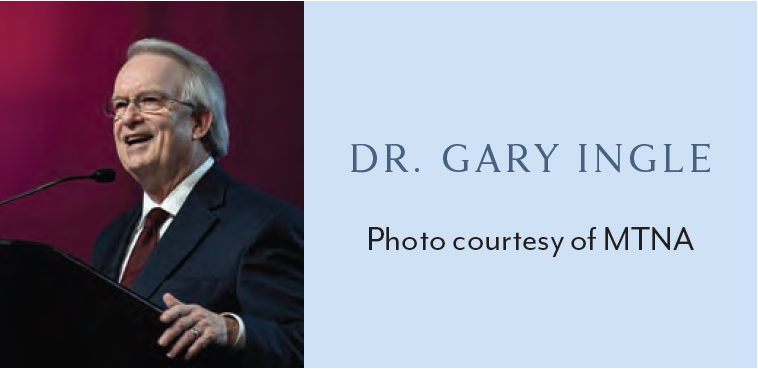
Leadership is a term that is frequently used. A quick google search reveals a range of characteristics, terminology, and definitions of success. The truth of effective leadership lies in the person—an individual who impacts a profession, motivates and inspires, builds community, navigates change, directs through crisis, builds connections, and creates new paths and resources for the future. In our field, Dr. Gary Ingle has exemplified inspired leadership for over twenty-eight years at the helm of the Music Teachers National Association (MTNA). This summer, Dr. Ingle will complete his tenure as CEO and Executive Director of MTNA. Gary, as he is known to most of us, has been a long standing friend and partner with the Center. Because of his expert leadership, we have benefited for decades from our rewarding collaboration with MTNA. Our founders, Frances Clark and Louise Goss, were passionate members of MTNA and worked with Gary to support piano teachers across the country. Our continued close relationship with Gary and MTNA has been one of the most important relationships for the Center and our shared, purposeful work.

As a leader in the profession, Dr. Gary Ingle has dedicated himself to advancing music education globally. The list of boards and associations he has served is broadly international and extensive. In his MTNA role, he worked tirelessly to advocate for the profession and actively built new networks. His vision propelled MTNA and the profession at large to be more broadly engaged. The long list of MTNA initiatives and programs developed under Gary’s leadership speaks to his creativity, collaborative approach, and service to all. As the largest and most influential organization in our field, MTNA leads and supports teachers across the country, as well as non-profit organizations like the Frances Clark Center and the larger music education industry.

We are all very grateful to Gary for his stewardship in recent years through the pandemic. Through his tenacious leadership, the profession remained resilient and relevant. We weathered the difficult times together as a community because MTNA continued to lead and inspire.

In addition to MTNA program advancement, Gary also led new opportunities through the creation of grants, scholarships, partnerships, and awards. Through tireless advocacy, Gary raised awareness and funds to support the future of the profession and elevate the contributions of many. For us at the Frances Clark Center, The MTNA Frances Clark Keyboard Pedagogy Award was established through a bequest to MTNA from Frances Clark. Throughout Gary’s leadership, the Center has worked closely with MTNA to recognize innovative new contributions to the field of piano education.

The steadfast vision for MTNA, passionate advocacy for music educators, tireless dedication, service to the community, and genuine care for all of us, make Dr. Gary Ingle one of the most transformative leaders in our history. His commitment to emerging professionals is unparalleled. Many of us built, and continue to build, our careers with opportunities provided through MTNA. Throughout my own career development, I have always upheld Gary as a kind and effective leader that one aspires to emulate. Gary’s expert leadership fervently supported the membership and the board, allowing new ideas to advance and flourish.

On behalf of the Frances Clark Center Board of Trustees, Staff, and Center community, present and past, we congratulate our friend and colleague Dr. Gary Ingle on his outstanding and impactful leadership. We look forward to his next stages and know that he will continue to contribute to the field in transformative ways that benefit music educators and amplify the power of music. We also congratulate the new MTNA CEO, Brian Shepard, as we look forward to our future collaborations.

Leveraging Artificial Intelligence in the Piano Studio


We would like to thank Omar Roy for this insightful article on artificial intelligence and its use in the piano studio. Want to learn more about artificial intelligence? Check out the latest issue of Piano Magazine. Our new summer issue can be found by clicking here.

In recent years, the proliferation of Artificial Intelligence (AI) has simultaneously caused both awe and controversy. Many express curiosity regarding how it works, what its limitations are, and how it might be used for their benefit. However, AI is not a new phenomenon and has been around for decades, with its development beginning as early as the 1940s and 1950s, most notably with the work of Alan Turing.1 On a more sophisticated scale, OpenAI’s “ChatGPT” has become almost ubiquitous with the term “AI,” though it is only one example of the extent to which AI has been developed. But what exactly is ChatGPT, and why is it so popular?

ChatGPT is a Generative AI (GenAI) constructed around a Large Language Model (LLM). According to Microsoft, a large language model is “a type of AI that can process and produce natural language text. It learns from…text data such as books, articles, and web pages to discover patterns and rules of language from them.”2 Whenever you send a text message, you’ll see predictive text suggestions to complete your message—that’s an LLM at work. ChatGPT happens to be one of the most comprehensive and most widely known. With the right prompts, ChatGPT can generate content that is surprisingly sophisticated, making it a powerful tool in the right hands.

ChatGPT and the Independent Piano Teacher

While much effort is being channeled into uncovering the latent possibilities for AI as a pedagogical aid, the use of AI in business-related administrative tasks is well documented.

Within the independent piano studio, teachers often act in other capacities. These include the roles of business owner, manager, customer service representative, and event planner, to name a few. Each of these roles is often laden with administrative responsibilities that can be time consuming. While there exists software to address many of the tasks that teachers may run into, some teachers may not yet have a large enough studio, or the revenue, to justify a subscription to a studio management system. In this article, we’ll explore a few examples of common tasks and how teachers can leverage ChatGPT to accomplish those tasks more efficiently.3

Remember, tools like ChatGPT
are LLMs – Large Language Models,
not creative thinkers or researchers.

Entering the AI Playground

Scheduling, for example, can be an extremely time-consuming task without the aid of some sort of scheduling software. ChatGPT makes swift work of collating multiple availabilities into a single schedule in mere seconds. Simply copying and pasting the various availabilities into the prompt area and asking ChatGPT to assign times based on mutual availability yielded the following result.

You:

Compile the following schedules of availability so that each person gets a single 1-hour meeting with me on either Monday or Tuesday between the hours of 9:00 AM to 5:00 PM. People may not share the same time with each other.

Michael: Monday 9:00am-12:00pm, 1:00pm to 2:00pm, 3:30pm – 4:30pm; Tuesday 12:00-1:00pm, 2:00pm-3:30pm

Vivek: Monday 9:00am-10:00am, 1:00pm to 2:00pm, 3:00pm – 4:30pm; Tuesday 12:00-1:00pm, 2:30pm-4:30pm

Xiaohan: Monday 10:00am-12:00pm, 1:00pm to 2:30pm, 3:30pm – 5:00pm; Tuesday 11:00am-1:00pm, 1:30pm-3:30pm

Stephanie: Monday 10:30am-12:00pm, 1:30pm to 3:00pm, 3:30pm – 4:30pm; Tuesday 12:00-1:00pm, 2:00pm-3:30pm

ChatGPT:

Here’s the compiled schedule with each person having a single 1-hour meeting with you on either Monday or Tuesday between 9:00 AM to 5:00 PM, and ensuring that no two people share the same time slot:

  • Michael: Monday 9:00am – 10:00am
  • Vivek: Monday 10:00am – 11:00am
  • Xiaohan: Monday 11:00am – 12:00pm
  • Stephanie: Monday 1:30pm – 2:30pm

All meetings are scheduled for 1 hour within your specified time frame, and each person has a unique time slot.

While this example involves only four students, it’s quite easy to scale this to larger numbers—if you have everything organized in a spreadsheet, you can even copy and paste the entire spreadsheet into the prompt box. Note that the current free version of ChatGPT (GPT 3.5) no longer supports document upload, so users must upgrade to the paid version (GPT 4.0) in order to access those features.

We hope you enjoyed this excerpt from Omar Roy’s article “Leveraging Artificial Intelligence in the Piano Studio.” To read the full article, please click here.

MORE ON ARTIFICIAL INTELLIGENCE

Not yet a subscriber? Join for only $7.99/mo or $36/yr.

NOTES
  1. Harvard Medical School. “A Brief History of Artificial Intelligence.” Harvard University. Last modified September 28, 2017. sitn.hms.harvard.edu/flash/2017/history-artificial-intelligence/.
  2. Microsoft. “Workshop: Interact with OpenAI Models.” Microsoft. microsoft.github.io/Workshop-Interact-with-OpenAI-models/llms/.
  3. OpenAI. “ChatGPT: Conversational AI developed by OpenAI.” OpenAI. openai.com/chatgpt.

The Piano Geeks: A Tribute to George Litterst


We would like to thank Shana Kirk for this tribute to George Litterst, one of last year’s Frances Clark Center Lifetime Achievement Award Winners. To read the full article with more tributes to George Litterst and Michelle Conda, click here.

George Litterst at NCKP 2023: The Piano Conference.

I first met George Litterst in 2000, when a mutual colleague dragged me across an exhibit floor, insisting that I see this laptop with a musical score scrolling across the screen while following the keyboard player’s tempo. That first introduction to George and his fledgling Home Concert 2000 software turned out to be a pivotal moment in my own professional development. It launched more collaborations that I can count, not to mention a decades-long friendship and an ever-growing collective of like-minded colleagues.

Following George’s enthusiasm for the cutting edge, our group of piano geeks has constantly pursued technology-based solutions to challenges a teacher, student, or performer could encounter. In the early 2000s, it was George’s tinkering with MIDI over dial-up Internet that laid a foundation for Internet MIDI software, now used worldwide for online piano teaching. Observing a need for more audience-friendly performances, George hacked together assorted technologies to create multimedia recitals that could be synchronized from a keyboard. Of course, it was also George who first advocated for efficiencies, such as chatting over AOL Instant Messenger, collaborating on proposals using Dropbox, and even traveling with GPS from a cell phone!

Beyond such measurable contributions, George has most significantly led by example with his spirit of generosity. If you have asked George a question at a conference, you may have found yourself huddled with him an hour later. If you asked a question online or sent an email, you may have received an invitation to a Zoom meeting so thorough that it could count as a college credit.

I know I am speaking for many in saying this spirit of generosity has lifted our profession in immeasurable ways. We are honored to be friends and colleagues and look forward to many more years of working together!

We hope you enjoyed this excerpt from the tributes to the Frances Clark Center’s Lifetime Achievement Award winners. You can read the entire article by clicking here.

MORE ON GEORGE LITTERST

Not yet a subscriber? Join for only $7.99/mo or $36/yr.

What is Appropriate at the Early Level for the Gifted Child? Do You Use a Method Book?


To celebrate the latest episode of Piano Inspires Podcast featuring Ingrid Clarfield, we are sharing an excerpted article with her commentary on how she works with children who are musically gifted. Want to learn more about Clarfield? Check out the latest installment of the Piano Inspires Podcast. To learn more, visit pianoinspires.com. Listen to our latest episode with Clarfield on Apple Podcasts, Spotify, YouTube, or our website!

Individual differences can be met by adjusting level, quantity, and goals…

To answer this question, I must first tell you my basic teaching philosophy: Students rise to the level expected of them. With that ideal I teach all students, adjusting my level of expectation with the “gifted” student. 

When selecting repertoire for early level students, I use materials that emphasize the following musical elements: 

1. Beautiful singing tone 

2. Melodic shaping 

3. Comprehension of the mood of the piece 

4. Balance 

5. Timing and intensity of goal notes

With gifted students I can incorporate these elements into their repertoire from the beginning. As they learn to read music, the emphasis includes reinforcing technique and listening skills. Philosophically, while I feel all students should be trained with these goals, it is easier for the gifted student.

To make these musical concepts more obvious, I often assign descriptive music. For beginners, I use The Music Tree series by Frances Clark and Louise Goss (Summy-Birchard). The words relate to the music and each piece is carefully designed to teach or reinforce a specific element. From day one, students are trained to LISTEN and think about the music’s meaning. While this method is good for all of my students, it is ideal for the gifted student. We just move faster and use more supplementary rote pieces and exercises. I particularly like The Music Tree series for teaching upper arm freedom and melodic shaping.

For specific repertoire, I assign music from all four periods. The gifted student is particularly intrigued by the variation of sound and technique that changes with the style. For Baroque music, I use the traditional, easier Bach pieces and the simpler Scarlatti Sonatas. The Introductory editions published by Alfred, Introduction to Handel, Introduction to Scarlatti, and others in this series provide excellent material. Other collections I use are the Early English Sonatinas edited by Rowley (Boosey & Hawkes) and two volumes of Very First Classics edited by Gray (Boosey & Hawkes).

The Classical period is amply represented by the standard Sonatinas plus the Mozart Viennese Sonatinas and the less difficult Haydn Sonatas. I encourage students to think orchestrally for a wide spectrum of sounds and distinct contrast in mood, touches, and dynamics.

The music of the Romantic period involves pedaling skills and rubato from the earliest stages. I applaud the Alfred Publishing Company for the choice of pieces in the Introduction to Chopin, Introduction to Grieg, and Introduction to Schumann editions. These collections include ideal pieces for work on the elements crucial to an understanding of the Romantic style.

The 20th century provides us with an abundance of outstanding early-level music by Prokofiev, Shostakovich, Kabalevsky, Bartok, and Gretchaninoff. This repertoire encourages communication of moods and a wide range of dynamics and touch. Two of my favorite living composers of effective descriptive pieces are Dennis Alexander and Seymour Bernstein.

We hope you enjoyed this excerpt from Clarfield and Appleby’s article about working with children who are gifted. You can read the entire article by clicking here.

MORE ON INGRID CLARFIELD

Not yet a subscriber? Join for only $7.99/mo or $36/yr.
A Lifetime Collaboration with Frances Clark


In honor of Teacher Appreciation Week, we are sharing this excerpted article by Louise Goss about her lifetime collaboration with Frances Clark. On behalf of The Frances Clark Center thank you to all teachers for sharing the incredible and transformative power of music.

The New School for Music Study.

Being invited to look at the changes in keyboard pedagogy over the last 20-30 years is a little like being asked to review my life. Piano Pedagogy and I grew up together, from 1945 until now.

I was born in Kalamazoo, Michigan, a small, vibrant city where music and the arts flourished. Except for very poor piano lessons, I had wonderful musical experiences — church and school choirs, orchestra and band, clarinet lessons and excellent vocal coaching, the local symphony and Community Concerts.

The early days with Frances Clark

By the time I got to college, I knew my future lay in music, and I also realized this meant becoming a better pianist. By great good fortune, my college piano teacher was Frances Clark, who had just joined the faculty of Kalamazoo College. “K” college was a liberal arts school, with a minimal music department. Adding Frances to their faculty was a bold step for a small college, but how bold they had no idea!

By my sophomore year, Frances had persuaded the administration to let her start a program in “piano teacher training” so that six of us undergraduate piano students could begin our training as teachers. Frances already had considerable experience in teaching teachers. She had developed a reputation as a teacher of exceptionally successful young students and was widely regarded for her imaginative ideas on teaching methods and materials. Other teachers began to come to her, first singly and then in groups, for what today we would call “piano pedagogy.” So, in a new college position, it was natural for her to think about how to help piano majors learn the basics of piano teaching.

Louise Goss
Frances’ first collegiate four-year piano pedagogy curriculum

Frances devised a curriculum for us: private lessons on our own repertoire, weekly lectures on the teaching/learning process and how it applied to piano, and demonstrations of her own extraordinary teaching of beginners and intermediate students in both private and group lessons. We studied the popular beginning piano methods of the day, and totally reorganized them under her guidance. We also began to work on supplementary study material to “fill in the holes.”

And so it was, that in my sophomore year, I was already embarked on two aspects of pedagogy which were to dominate the rest of my professional life: a study of the teaching/learning process and how to apply it most effectively to piano teaching, plus an attempt to create better, more comprehensive, more creative teaching materials. By our junior year, each of us was assigned one or two beginners in a study program called “the two-and-one plan.” Frances taught the first lesson while we observed and took notes. We taught the next two lessons, she taught the fourth, etc. In retrospect, I find it fascinating that she never watched us teach. Apparently she learned all she needed to know about our teaching by teaching our students. Each of these lessons was followed by a conference with us on what we were doing right, what we might improve, and how to improve it.

In our senior year, we taught the private lessons from her beginner’s classes, and began to experiment with intermediate level students, still on the two-and-one plan. By the time I graduated (1948), “K” College already had in place what was probably the first 4-year program in piano pedagogy in a college or university anywhere. This little liberal arts college, with a great reputation in English and science, unwittingly found itself at the forefront of an important new movement in the training of piano teachers.

That summer, Frances invited me to help her give her first “Workshop for Piano Teachers.” Three days long, it included lectures, teaching demonstrations, discussion periods, and student recitals. About 35 teachers attended the first of what were to become annual summer study courses, extending over the next 50 years and across the length and breadth of the country.

A time to begin

Frances also asked me to help her put together the supplementary reading materials we had been developing in our pedagogy courses. She took them to the Clayton F. Summy Publishing Company (later to become Summy-Birchard) in Chicago, where they were immediately accepted and published as The ABC Papers. This simple little book of intervallic reading drills was without precedent and became an instant success.

I was at the University of Michigan for doctoral study in musicology when Frances received an intriguing invitation. Summy asked her to study their keyboard catalogue and arrange it in an order that made pedagogical sense. She countered that if they wanted a real “method,” she would need to start from scratch and create one that followed the learning principles and curriculum guidelines she had been developing over the years. Hearing I was to be included in this project, I joyously abandoned the doctorate, went back to Kalamazoo, and began an adventure that lasts even today.

We hope you enjoyed this excerpted article by Louise Goss. To learn more about her collaboration with Frances Clark and read the full article, click here.

MORE ON THE NEW SCHOOL FOR MUSIC STUDY

Not yet a subscriber? Join for only $7.99/mo or $36/yr.

A Continuum Between Teaching Styles: Reflections from the US and Chile


We would like to thank Paulina Zamora for this insightful article on her experiences growing up as a musician in Chile. Want to learn more about international teaching practices and repertoire? Register for our 2024 Summer Intensive Seminar “An International Exploration of Piano Teaching Literature” lead by Leah Claiborne and Luis Sanchez. Early bird registration pricing has been extended until May 15, 2024! Learn more and register here.

My trajectory as a concert pianist, teacher, and scholar followed a similar international pathway as many musicians whose native origins are far from the traditionally accepted educational music centers of the world. I excelled in my native Chilean environment until completion of my undergraduate degree and went on to graduate studies abroad. After twenty years of artistic and professional career growth, I returned to Chile and began to forge a teaching career in academia, while steadily building international opportunities for performances and masterclasses.

My beginnings were similar to that of a child prodigy, but I prefer to think that I was a very talented girl with lots of potential and a serious, no-nonsense attitude. From the age of five I intuitively knew I would dedicate my life to music. As the youngest of three sisters, my father’s immediate attention went to fostering a musical upbringing in my oldest sister. I can recall interrupting my sister’s piano lessons and begging my father to teach me as well. After many bold attempts for attention, my father conceded. It is so meaningful to me that as adults, my oldest sister became a beautiful ballet dancer and I am now a professional pianist. We often rejoice in the commonalities between these two art forms.

The Music Department at the University of Chile offers an eight-year pre-collegiate program which is referred to as the Basic Period (conservatory level) and a five-year Undergraduate degree. I undertook studies at both levels, receiving the standard two piano lessons per week during both courses of study. During the Basic Period, piano lessons were complemented with fundamental courses such as Theory, Harmony, and Introduction to Music History. While pursuing my undergraduate, I received the traditional curriculum of a bachelor’s degree in the United States. Furthermore, during my early conservatory years, I would spend summers receiving daily piano lessons. An outcome of this intense training was to play my first formal recital at age nine, performing from memory the fifteen two-voice Inventions by Bach. This was followed, a year later, by the Fifteen Sinfonias. At that time, I did not feel comfortable questioning my teachers or proposing different options and, of course, this exercise gave me invaluable lessons in self-discipline and focus. Years later I would return to these works in recording and editing projects. Having said all of that, I do refrain from reassigning this task to young students of my own!

Pursuing graduate studies in the Unites States presented all sorts of enlightenment and change. The most obvious difference was the adjustment from two or more hours per week of lessons to just to one hour per week, and sometimes less if the artist-teacher was away. The reasoning behind this amount of instruction made sense to me, but it took me a few months to adjust. Ultimately, acquiring self-reliance and independent musical thinking was a valuable lesson from those years.

During my studies at the Eastman School of Music and Indiana University, I had moments to reflect on the wonderful teaching I had received in Chile, while also embracing the opportunity to understand more fully what still needed to be learned. I was mesmerized by the infrastructure of the schools: the buildings themselves, the magnificent libraries, the many practice rooms with decent pianos, stunning concert halls, and the rich musical life of each respective city. The academic level of both schools was outstanding, and I felt this from my first days of attending music-related classes.

We hope you enjoyed reading this excerpt from Paulina Zamora’s article, “A Continuum Between Teaching Styles: Reflections from the US and Chile.” Read the full article by clicking here.

MORE ON LATIN AMERICAN MUSICIANS AND COMPOSERS

Not yet a subscriber? Join for only $7.99/mo or $36/yr.

It is essential that the focus be on how…


We would like to thank Jane Magrath for this insightful article. Want to learn more about teaching piano technique? Join us on Wednesday, April 17th at 11:00am ET for our latest webinar, Foundations on Technique, with Julie Hague and Alejandro Cremaschi, host. To learn more and register, click here.

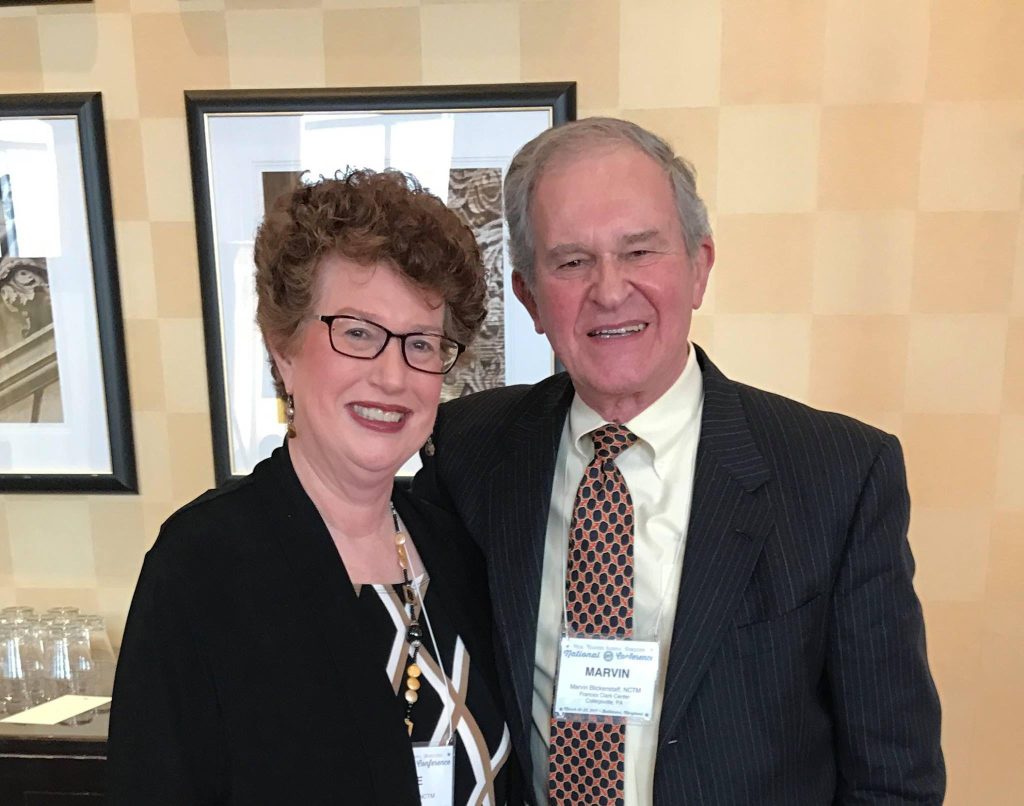
Jane Magrath and Marvin Blickenstaff

The first years of piano study are critical ones for developing technique in the young student. The extent to which various elements of playing are developed in the early years should be greatly expanded. 

Central to the development of technique in the very first year is the establishment of a good hand position and the establishment of the ability to move freely about the keyboard. Equally important is the development of control of the large playing units-upper arm, forearm, and wrist-then moving to the smaller units in the hand. 

How should these principles for the first year be extended over several years of piano study? Surely proficient technique involves most importantly the ability to control sound and tone as well as the ability to move quickly. The establishment of a proficient technique also involves the ability to playa series of patterns commonly found in piano music in a variety of combinations. Pianists at all levels concentrate heavily on the playing of scales, arpeggios, and chords (as well as double notes, octaves, trills and so on). 

What do we teach, then, in the early years? Many teachers begin to prepare students to play scales using five-finger pattern exercises played in all keys. Some also use selections from,a wealth of classical etudes that rely heavily on passagework for developing finger facility in scale passages. The playing of arpeggios is often first prepared by the playing of broken chord patterns in hand-over-hand fashion. Other miscellaneous aspects of technique essential at this level, such as expansions-contractions of the hand, are taught through teacher-devised exercises or through various technique books.

Unfortunately, it seems rare for many students in the second through fourth years to extend chord playing beyond the playing of the common-I N6/4 I V6/5 I-chord activity in various keys. Chord inversions, for example, both blocked and broken, need to be carefully prepared and presented to students. The playing of triads up and down the keyboard (in the various registers) with facility is essential. Students need to practice, even at the earliest levels, voicing chords in various ways-balancing between the hands, of course, but also voicing the various notes of a chord within a hand for projection. Students should learn to play various chords and inversions after a bass octave to prepare for the “oom-pah-pah” accompaniments of many pieces in the intermediate repertoire. Finally, students need to experience the shape and feel of dominant and diminished seventh chords in all positions, and develop a natural feeling for these chords that become so important in intermediate literature. The facile playing of chords is an essential and often-overIooked aspect of playing. 

All in all, we focus well on the what that is taught for technique (such as which chord patterns or which scale patterns or which etude books are used). Should we not be focusing more on how the technique is taught? At all levels, goals for technical concepts should concern quality of sound, the focus on the correct hand position and use of the fingers, the production of sound from the correct source, the correct physical motion in moving to a chord, and so on. To achieve a fully developed technique, it is essential that the pedagogical focus be primarily on how the sounds and gestures are produced and on listening perceptively to evaluate success. Technical development is most effectively, but not exclusively, transmitted through meaningful hands-on experience: private and group piano lessons, participation in and observation of master classes, observation of video tapes and live performances, analysis and listening in individual practice, and through observation/trial at workshops. (Recall how difficult it is to read a technique book on physical gestures.) 

We hope you enjoyed this excerpt about Jane Magrath’s approach to technique for beginning and intermediate students. Read the full article including additional thoughts by Scott McBride Smith, Miyoko Nakaya Lotto, and Louise Savage by clicking here.

MORE ON TECHNIQUE

Not yet a subscriber? Join for only $7.99/mo or $36/yr.
A Continuum Between Teaching Styles: Reflections from the US and Chile


We would like to thank Paulina Zamora for this insightful article on her experiences growing up as a musician in Chile. Want to learn more about international teaching practices? Attend our webinar, “International Perspectives: Piano Methods from Different Corners of the World,” with guests Yuval Admony, Rae de Lisle, and Carla Reis, with Luis Sanchez, host. The webinar is today, April 3rd at 11am ET. Learn more and register here.

My trajectory as a concert pianist, teacher, and scholar followed a similar international pathway as many musicians whose native origins are far from the traditionally accepted educational music centers of the world. I excelled in my native Chilean environment until completion of my undergraduate degree and went on to graduate studies abroad. After twenty years of artistic and professional career growth, I returned to Chile and began to forge a teaching career in academia, while steadily building international opportunities for performances and masterclasses.

My beginnings were similar to that of a child prodigy, but I prefer to think that I was a very talented girl with lots of potential and a serious, no-nonsense attitude. From the age of five I intuitively knew I would dedicate my life to music. As the youngest of three sisters, my father’s immediate attention went to fostering a musical upbringing in my oldest sister. I can recall interrupting my sister’s piano lessons and begging my father to teach me as well. After many bold attempts for attention, my father conceded. It is so meaningful to me that as adults, my oldest sister became a beautiful ballet dancer and I am now a professional pianist. We often rejoice in the commonalities between these two art forms.

The Music Department at the University of Chile offers an eight-year pre-collegiate program which is referred to as the Basic Period (conservatory level) and a five-year Undergraduate degree. I undertook studies at both levels, receiving the standard two piano lessons per week during both courses of study. During the Basic Period, piano lessons were complemented with fundamental courses such as Theory, Harmony, and Introduction to Music History. While pursuing my undergraduate, I received the traditional curriculum of a bachelor’s degree in the United States. Furthermore, during my early conservatory years, I would spend summers receiving daily piano lessons. An outcome of this intense training was to play my first formal recital at age nine, performing from memory the fifteen two-voice Inventions by Bach. This was followed, a year later, by the Fifteen Sinfonias. At that time, I did not feel comfortable questioning my teachers or proposing different options and, of course, this exercise gave me invaluable lessons in self-discipline and focus. Years later I would return to these works in recording and editing projects. Having said all of that, I do refrain from reassigning this task to young students of my own!

Pursuing graduate studies in the Unites States presented all sorts of enlightenment and change. The most obvious difference was the adjustment from two or more hours per week of lessons to just to one hour per week, and sometimes less if the artist-teacher was away. The reasoning behind this amount of instruction made sense to me, but it took me a few months to adjust. Ultimately, acquiring self-reliance and independent musical thinking was a valuable lesson from those years.

During my studies at the Eastman School of Music and Indiana University, I had moments to reflect on the wonderful teaching I had received in Chile, while also embracing the opportunity to understand more fully what still needed to be learned. I was mesmerized by the infrastructure of the schools: the buildings themselves, the magnificent libraries, the many practice rooms with decent pianos, stunning concert halls, and the rich musical life of each respective city. The academic level of both schools was outstanding, and I felt this from my first days of attending music-related classes.

We hope you enjoyed reading this excerpt from Paulina Zamora’s article, “A Continuum Between Teaching Styles: Reflections from the US and Chile.” Read the full article by clicking here.

MORE ON LATIN AMERICAN MUSICIANS AND COMPOSERS

Not yet a subscriber? Join for only $7.99/mo or $36/yr.
Norwegian Folk Songs: Making Rhythmic Complexities Easy and Enjoyable


We would like to thank Sarah Jenkins, our 2020 Collegiate Writing Contest Winner, for this insightful article on Norwegian folk songs. Are you a student interested in sharing your research and projects with the piano pedagogy community? On Friday, April 26th at 11am ET, the Frances Clark Center is hosting “Collegiate Connections,” an event to celebrate collegiate groups and their innovative projects. Learn more and submit a proposal, click here. The deadline is tomorrow, April 2nd!

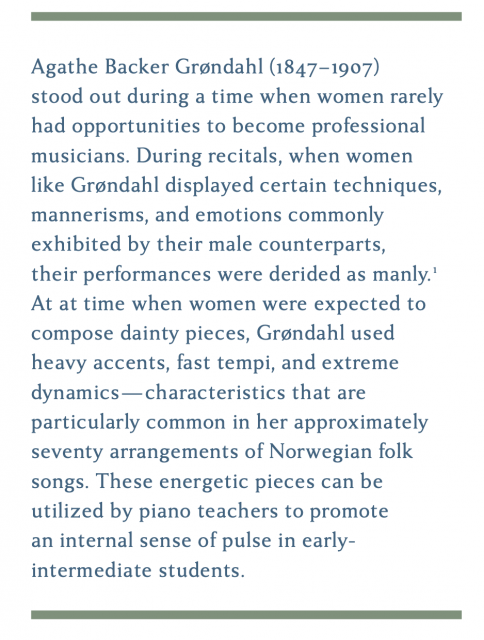
Developing an internal sense of metric pulse and an understanding of subdivisions of beats is essential to the success of a young performer. Without establishing a strong sense of pulse, complex rhythms can be played incorrectly. This is too often a source of frustration for students—and teachers. By choosing repertoire where these aspects are highlighted and emphasized, students gain confidence in these areas of their musical training. Some of the standard teaching repertoire used for rhythmic development can be unappealing to students, due to a seemingly high level of difficulty or lack of interest in the character. The good news is these pieces do not have to be boring—they can be fun to learn and entertaining to play! Assigning pieces that have appealing melodies and fun character will motivate students to push through the potential rhythmic challenges. Two pieces by Agathe Backer Grøndahl, Springdans from Op. 30 and Halling from Op. 33, provide examples of how her arrangements of Norwegian folk songs offer students exciting tunes that also serve as exercises to promote rhythmic development.

Springdans, Op. 30 and Halling, Op. 33 are similar in many ways. They both offer students sources of metric pulse that allow them to further internalize the beat, and they both have lively and animated melodies. Because they are folk songs, each has a continuous, easy-to-follow melody throughout. These two pieces pair nicely together because they offer similar skills that are presented in different ways. Where Springdans offers a strong left-hand position and a grounding right-hand finger one as means for metric support, Halling contains sections that have an ostinato quarter-note pattern that is played primarily by finger five in the right hand. Students will be able to transfer the concepts learned in Springdans, where the supporting elements were more prominent, to Halling, where the rhythmic stabilizers require more sophisticated skill.

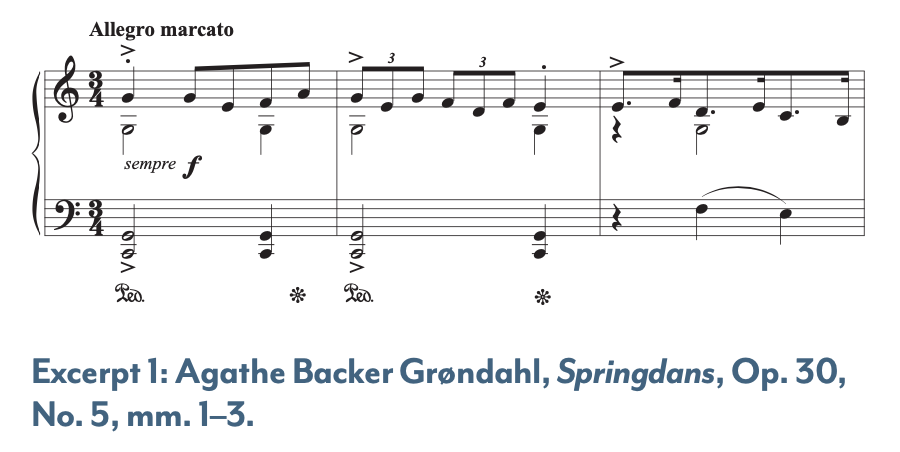
This springdans (leaping dance for men) is bouncy, fast, and rhythmically diverse. A forte dynamic marking and accented rhythms, combined with a melody that primarily uses steps and skips, create a fun and lively opening section. There are three distinct rhythmic patterns used throughout. These increase in complexity as the piece moves forward. Within the first three measures, the piece moves from a quarter note, to eighth notes, to triplets, to dotted-eighth sixteenths (see Excerpt 1).

A student might struggle with the juxtaposition of these rhythmic patterns. However, Grøndahl uses accented half-note and quarter-note accompaniment patterns to support the rhythmically complex melody. The open fifth in the left hand is commonly used in beginning method books and repertoire because it creates a strong, but comfortable, hand shape. In this piece the hand position is coupled with an accent—allowing for an overemphasized downbeat. The first finger in the right hand shares this accented rhythm, also giving the right hand a source of stability. Using fingers one and five, the right-hand octave downbeats also help create a strong hand position. Although playing multiple rhythmic subdivisions in succession can be challenging, students will find that the sources of rhythmic stability will help them in maintaining the metric pulse.

We hope you enjoyed this excerpt from Sarah Jenkin’s article, “Norwegian Folk Songs: Making Rhythmic Complexities Easy and Enjoyable.” To read the full article, click here.


Collegiate Essay Winner: Emerging Adulthood and Undergraduate Group Piano


We would like to thank Melody Morrison, who was named the winner of the 2023 Collegiate Writing Contest, for this insightful article on adulthood and collegiate group piano. Are you a collegiate student interested in submitting your writing to the Piano Magazine? We encourage all collegiate students to enter the 2024 Collegiate Writing Contest! Materials are due on May 1, 2024. To learn more and submit an article, click here.

Typical college students find themselves in a phase of life that has been identified as “emerging adulthood”— a time when characteristics of both children and adults are present in individuals who are in their late teens to early twenties.1 Collegiate group piano classes consist of mostly first- and second-year students (likely seventeen to twenty years old) and are in the beginning stages of emerging adulthood.2 Because the students who are in undergraduate group piano classes exhibit traits of children and adults, elements from both pedagogical and andragogical teaching approaches should be applied. It is therefore beneficial for a teacher to understand the teaching methodologies which highlight the adjustment of one’s teaching style according to the age of the student.3

This discussion will synthesize the research literature related to the differences between pedagogy and andragogy, and undergraduate class piano. In conclusion, implications and suggestions for teaching undergraduate class piano and this age population will be presented.

Pedagogy and Andragogy: History, Characteristics, and Differences

Pedagogy has often been used to encompass learning in all stages of life. However, the word “pedagogy” is derived from the Greek words paidos and agogus which translate to “child” and “leader of” respectively.4 Pedagogy, therefore, can be defined as the art and science of teaching children.5 European monks between the seventh and twelfth centuries began to observe how children learn and developed the first pedagogical concepts. Ideas from this era were eventually seen in schools throughout Europe and North America in the eighteenth and nineteenth centuries, and educational psychologists continued to study and develop the pedagogical model.6

A new focus on effective adult learning within the United States in the 1920s demonstrated that pedagogical concepts did not appear to work with the same success rate in adult students. Different teaching methods for adults began to develop throughout the twentieth century, and in the 1960s American educator Malcolm Knowles popularized the term andragogy. Andragogy originates from the Greek words aner whose stem andra means “man,” not “boy,” and agogue which means “leader of.” Knowles emphasized that andragogy was different from pedagogy, the latter referring to the education of children.7

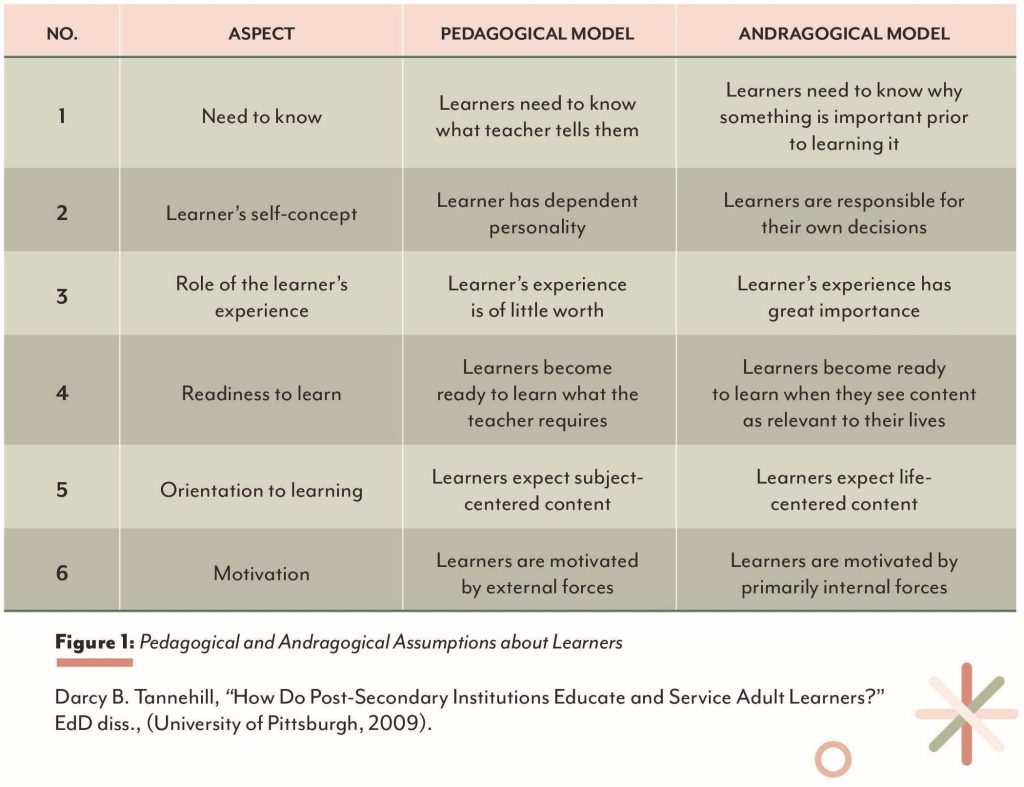
The differences between pedagogy and andragogy can be summarized in six “assumptions” found in Figure 1.8 One of the noticeable differences between children and adult learners is that children often willingly receive instructions from a teacher if the directions are clear, while an adult learner will want to know the importance of a concept before they take the time to study it. Adult learners also carry with them many life experiences which will affect numerous areas of their learning.9 Children on the other hand come to a learning environment with more of a “clean slate.” Another difference between pedagogy and andragogy is that children often are motivated by outside forces, while adults demonstrate more internal motivation.10 Lastly, adults have shown preference toward self-directed learning.11

If you enjoyed this excerpt from Melody Morrison’s article “Emerging Adulthood and Undergraduate Group Piano,” you can read more here: https://pianoinspires.com/article/collegiate-essay-winner-emerging-adulthood-and-undergraduate-group-piano/.


MORE ON GROUP PIANO

Not yet a subscriber? Join for only $7.99/mo or $36/yr.
SOURCES

1 Jeffrey J. Arnett, “Emerging Adulthood: A Theory of Development from the Late Teens through the Twenties,” American Psychologist 55, no. 5 (2000): 469–480.

2 Christopher Fisher, Teaching Piano in Groups (New York: Oxford University Press, 2010); Pamela D. Pike, Dynamic Group-Piano Teaching (New York: Routledge, 2017).

3 Malcolm S. Knowles, The Modern Practice of Adult Education: From Pedagogy to Andragogy (Englewood Cliffs: Cambridge Adult Education, 1980); Joseph Mews, “Leading through Andragogy,” College and University 95 (2020): 65–68.

4 Malcolm S. Knowles, The Adult Learner: A Neglected Species (Houston: Gulf Publishing Company, 1973); Malcolm S. Knowles, Elwood F. Holton III, and Richard A. Swanson, The Adult Learner (New York: Taylor & Francis, 2012).

5 Geraldine Holmes and Michele Abington-Cooper, “Pedagogy vs. Andragogy: A False Dichotomy?” The Journal of Technology Studies 26 (2000). doi.org/10.21061/jots.v26i2.a.8

6 Knowles, The Modern Practice of Adult Education.

7 Ibid.; Joseph Davenport, “Is There a Way Out of the Andragogy Morass?” Lifelong Learning 11, no. 3 (1987): 17–20.

8 Darcy B. Tannehill, “How Do Post-Secondary Institutions Educate and Service Adult Learners?” EdD diss., (University of Pittsburgh, 2009).

9 Sang Chan, “Applications of Andragogy in Multi-Disciplined Teaching and Learning,” MPAEA Journal of Adult Education 39, no. 2 (2010): 25–35.

10 James A. Draper, “The Metamorphoses of Andragogy,” Canadian Journal for the Study of Adult Education 12, no. 1 (1998), 3–26; Mews, “Leading through Andragogy.”

11 Sharan B. Merriam, “Andragogy and Self-Directed Learning: Pillars of Adult Learning Theory,” New Directions for Adult and Continuing Education, (Spring 2001): 3–14. doi.org/10.1002/ace.3

Spring 2021: Pupil Saver: Adagio in F Minor by Chevalier de Saint-Georges


We would like to thank Leah Claiborne for this insightful article on Chevalier de Saint-Georges’s Adagio in F Minor. Want to learn more about Black composers? Check out our latest publication of Thomas Henderson Kerr Jr.’s Didn’t My Lord Deliver Daniel? for two pianos! This publication, spearheaded by Susanna Garcia and William Chapman Nyaho, is the first in a series of three publications of Kerr’s piano works by the Frances Clark Center. Learn more and order a copy here.

Can you imagine performing a piece by a Black composer who was born into slavery? What a piece of history you would have at your fingertips!

Chevalier de Saint-Georges (1745–1799) was a virtuoso violinist, conductor, and composer. Born in Guadeloupe, his father was a wealthy plantation owner and his mother was enslaved on the plantation. His father took him to Paris, France when he was seven years old to further his education. He became a leading concertmaster in Paris, performing his own violin concerti, and concerti that were dedicated to him by other leading composers of the time. Some of these composers include Antonio Lolli and Carl Stamitz. Chevalier de Saint-Georges composed operas, solo vocal and instrumental works, chamber music, and symphonies. All of the music that this composer created is hardly ever performed, but that can change right now by incorporating Adagio in F Minor into your repertoire.

Adagio in F Minor is a solemn, expressive piece that would be a wonderful predecessor before a student tackles Clementi sonatinas. It can be challenging for teachers to find music that bridges the gap between method book repertoire and sonatinas, as well as the transition from sonatinas to sonatas. Adagio in F Minor fits perfectly into an early-intermediate pianist’s studies. This piano piece in F minor features a melancholic melody with expressive harmonic support (see Excerpt 1). The musical maturity needed for this piece often makes this a favorite amongst intermediate adult students as well. 

Excerpt 1: Chevalier de Saint-Georges, Adagio in F Minor, mm. 1-4

CHALLENGE #1

The student is asked to perform scale passages in thirds in the right hand (see Excerpt 2). The thirds in Adagio in F Minor are beautifully intertwined with the melody and should be voiced to the top note. A similar example of right-hand thirds being used as the melody in the teaching repertoire is found in Czerny’s 100 Progressive Studies, Op. 139, No. 38 in G major, which can be a great companion etude when a student is learning this piece (see Excerpt 3). 

Excerpt 2: Chevalier de Saint-Georges, Adagio in F Minor, mm. 8-10.
Excerpt 3: Carl Czerny, 100 Progressive Studies, Op. 139, No. 38, mm. 1-4.

We hope you enjoyed this excerpt from Leah Claibornes’s article “Spring 2021: Pupil Saver: Adagio in F Minor by Chevalier de Saint-Georges.” You can read more by clicking here.

MORE ON DIVERSITY, EQUITY, AND INCLUSION

Not yet a subscriber? Join for only $7.99/mo or $36/yr.

Search
Piano Inspires logo featuring stylized diagonal stripes in orange, gold, and teal, next to the text 'Piano Inspires' in bold black lettering.