


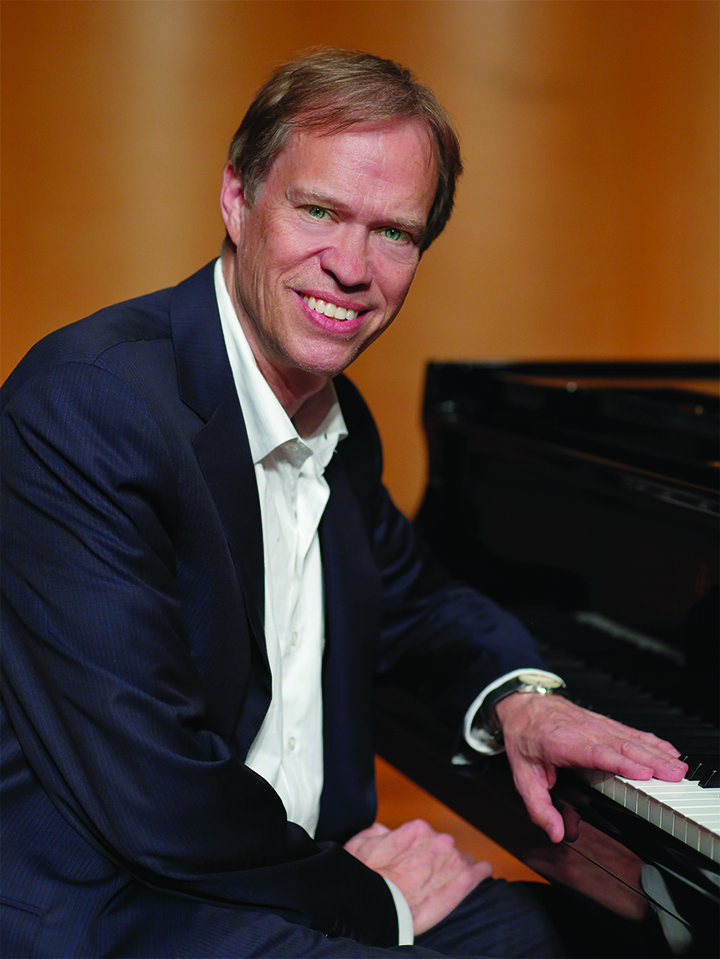
To celebrate the latest episode of the Piano Inspires Podcast featuring Randy Faber, we are sharing an excerpted transcript of his conversation with Jennifer Snow. Want to learn more about Faber? Check out the latest installment of the Piano Inspires Podcast. To learn more, visit pianoinspires.com. Listen to our latest episode with Faber on Apple Podcasts, Spotify, YouTube, or our website!
Jennifer Snow: Did you ever imagine the scale of impact and influence? So here you both are, earnestly serving the art, serving your students, wanting something inspiring, not what you had at the lunch hour. Lighting the fires motivated by diversity of experience and style, bringing in a real deep—like you say—the R&D understanding of what works, what do children respond to?
So it was really this incredible research project driven by love and passion for teaching. When you let that go into the world, when you were at that stage, did you two of you look at each other and say, “Wow, like this has just taken on a life of its own.” I mean, it’s the premier method book for learning piano for decades.
Randy Faber: Yeah. It’s kind of funny. On the one hand, you know, all we wanted to do is make a decent livelihood, right? And there was one thing about it.
JS: What is it—necessity is the mother of invention.
RF: That was it, exactly. I remember when I was in that music store at age sixteen, teaching, right? I would look at all of these publications there, and I just remember saying, “I could do that.” I would see my name on those books, and isn’t that funny? But it wasn’t so much that it was a proactive decision: this is my goal, I’m going to write this down, sort of thing to do. It was more I knew there’s an upward trajectory. I knew where I—I didn’t know exactly what the ascent is. But I had two thoughts on that, and maybe it’s a little profound. But for one, I didn’t know where the ascent would be, but I didn’t want there to be a top on it.
JS: Right.
RF: So I didn’t place a top on it. And that’s a little bit like the aspiration to goodness and godliness, right? That’s why the God is infinite and ineffable. So if it’s ineffable, yeah. If we could really isolate to say what it is, well then, if you hit it, you’re done, right? I mean, it has to be infinite.
And that’s what actually drew me to music, because—a little story when I was a child, when I was in high school, I had two scholarships to Interlochen. I had to choose between which one I wanted, and I was the political camp boys town, I think it was called that. They’d have us to represent the school there. And I just represented the school in a math competition. So, I had all these things. Okay, what am I going to do this summer? Which one? And I was zeroing in on music because music was ineffable, and music had the endless, infinite aspiration.
JS: Yes, I relate to that.
RF: Do you relate to that, too?
JS: 1000 percent.
RF: How’s your story on that one?
JS: It is so close to yours, that feeling that there is no end.
RF: Yes.
JS: That you’re never there. That there’s the constant pursuit, the constant creativity, the constant aspirational sort of the feeling of nothing like this openness that’s sort of above you.
RF: In a way, that’s a good fortune that we found that you know, and I kind of think for myself, I think it was lucky that I found that. And maybe it was of my religious upbringing, as kind of like, you know, not my will, but God’s will.
JS: That’s right: bigger than you. There are things bigger than us.
RF: There’s something that’s bigger than me that I can’t have the foresight to see where that’s going. But there is some direction. I could always know the upward direction.
JS: Right.
RF: And that’s what I aspired and that worked for me, because I don’t think either Nancy or I ever anticipated that strength—I mean the kind of success globally. But we didn’t doubt it either.
JS: That’s right.
RF: And I think that’s part of it. When we wrote the method, we knew it was good, and we knew it was good when we brought it to publishers, and we knew we were just going to make it better.
And then, you know, a lot of this is people talk about talent so much, and then maybe this is a good place just to, you know, maybe lay that to rest. Right?
JS: Right.
RF: Because talent is action. Talent is hard work. And you build your skills and you layer your skills, but you have the right coaching so you get it right and you have your, you know, your bones at it. And yet at the same time, you have a very open view, so you can take the opportunities as they’re presenting. And I think we had good fortune, obviously. A lot of it, there’s always the luck of being in the right place. But as the old adage too is, if you’re prepared and then the opportunity comes, you could walk. If I couldn’t sit down and read that score or do that improvisation, I wouldn’t have the contract. So that’s been preparation. And so, grabbing those opportunities as they come and then at whatever plateau you are, you’re seeing what’s the next window open. Like we were really faced with the decision to—you know, we finished level four of the Piano Adventures method and we told our publisher, “Okay, where’s the party?” You know, and he goes, “You’re not done yet.” To him that’s just a textbook, but it’s that hard work. We worked. We worked really like—seriously—like dogs, but without that, we wouldn’t have gotten all those scores done. Right? And so we’re proud of it. And, you know, would we do it again? Well, yeah, I suppose we would, but we had no idea how much work it was going to be to get where we wanted to go. And I think that’s again, that’s the optimistic bias of the human species, I think, and that’s what allows us to thrive, because we can strive without burning out. If we knew ahead of time how much work it is, we might not make the attempt. That’s a bit. I don’t mean to say that to Piano Inspires.
JS: But it’s true.
RF: But the truth of it is, yeah, you need to work hard and learn to work hard and learn to enjoy working hard.
JS: That’s right.
RF: And I think that’s the part. Would we do anything else people ask us often? Well, no, I love what I do. You know it. This is where we are meant to be, where everything converges in terms of the artistry, the creativity, and the backgrounds, and it all seemed to converge towards this kind of contribution to society.

This episode of the Piano Inspires Podcast is generously sponsored by Faber Piano Adventures. If you enjoyed this excerpt from Piano Inspires Podcast’s latest episode, listen to the entire episode with Randy Faber on Apple Podcasts, Spotify, YouTube, or our website!
MORE ON RANDY FABER
- PIANO MAGAZINE ARTICLE: An Interview with Randall and Nancy Faber by Steve Betts
- PIANO MAGAZINE ARTICLE: What is Your Plan for Teaching A New Piece? How Does It Vary for Different Levels of Students? by Bruce Berr
- PIANO MAGAZINE ARTICLE: What I’ve Learned from 150 Podcast Episodes… and Counting by Tim Topham
- PIANO MAGAZINE ARTICLE: From notes to beauty: When, why and how? by Craig Sale and Nicole Martens
- PIANO MAGAZINE ARTICLE: Improving Sight Reading at the Piano and the Potential of Technology in the Future by Le Binh Anh Nguyen
- PIANO MAGAZINE ARTICLE: 2017 Clavier Companion Collegiate Writing Contest Winner: The Actual Children’s Corner: Making Impressionistic Music Accessible to Elementary and Intermediate Piano Students by Hayden Coie
- PIANO MAGAZINE ARTICLE: How Do You Teach the Dotted-Quarter Eighth Note Rhythm? by Craig Sale
Not yet a subscriber? Join for only $7.99/mo or $36/yr.
Want more than a preview?
Subscribe to unlock full videos, webinar archives, and articles!


